


 Home

What is distributed data acquisition for rail vehicles?

Modern trains are complex high-tech systems: high-performance traction drives, sophisticated bogies, tightly integrated control and power systems, and passenger comfort modules packed into limited space. This is why testing them requires data from hundreds of sensors—installed across multiple cars, from the bogie to the roof.
While centralized DAQ architectures quickly hit their limits, testing with a distributed data aquisitions systems capture signals right where they originate - synchronously across all measurement points, with robust hardware and high signal integrity. The result is a precise, system-wide view of the vehicle.
Requirement | Distributed DAQ approach |
Long trainsets | DAQ nodes positioned near measurement points |
Hundreds / 1,000+ channels | Modular, scalable architecture |
Signal quality | Short analog signal paths |
Cross-car analysis | Synchronized acquisition |
Harsh rail environment | Rugged measurement hardware |
Central operation | One measurement software environment |
Why is data acquisition across an entire train challenging?
Explore proven applicationsRail environments push measurement systems harder than almost any other application. From cabling along an entire train, to multi-channel measurements, harsh environments and electromagnetic interference to changing test setups, data acquisition solutions need to deliver reliably with a high data quality.
How does distributed data acquisition work on a train?
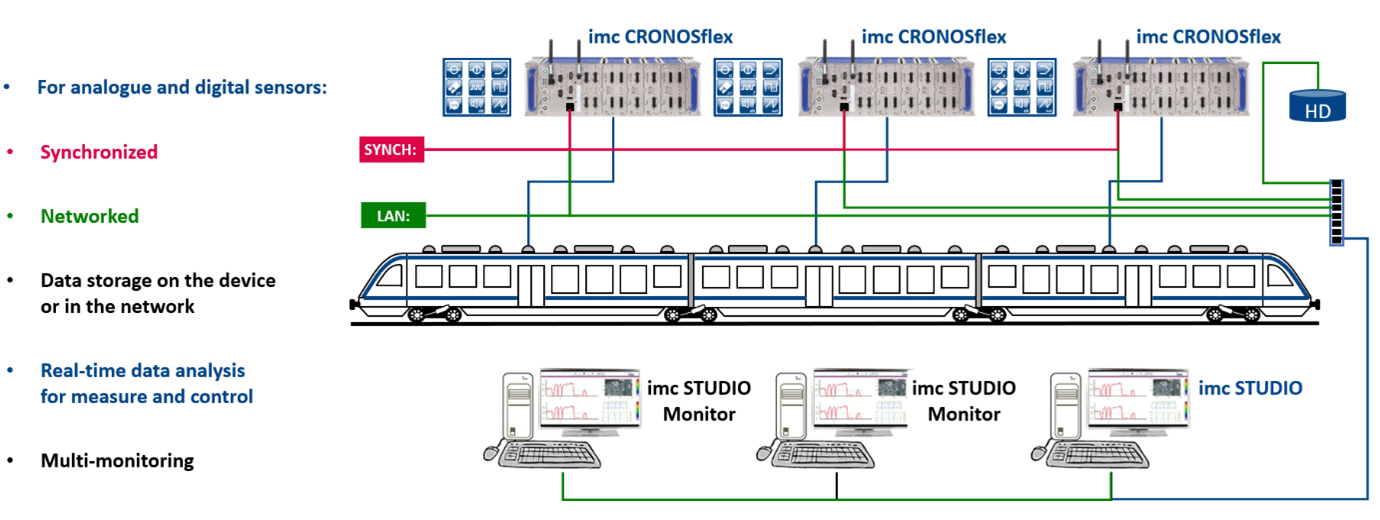
One workflow from measurement setup to analysis:
- Decentralized distributed measurement setup close to the sensor.
- All imc DAQ systems can be synchronized sample-accurately.
- The measurement modules are networked via high-speed, real-time buses.
- Data is stored on the device or in the network.
- Centralized Control with the measurement software imc STUDIO and real-time calculations within the device.
- Everything from a single source: Seamless integration of measurement data into data analysis tools like FAMOS and database installation following the ASAM ODS standard.
What are the key elements of a distributed DAQ workflow?
The imc DAQ platforms, like imc CRONOSflex and imc ARGUSfit follow the same principle: measurement modules are positioned close to the sensors, digitizing signals right at the source and transmitting them synchronously across the train.
High electromagnetic loads can lead to signal recording failures and need a measurement architecture that is robust and safe against EMI. Other harsh conditions include temperatures from –40 °C to +85 °C (–40 °F to +185 °F), vibration, shock, spray water and stone debris or ice debris. imc DAQ systems are designed for real-world rail conditions: shock- and vibration-proof, with optional extended temperature range from –40 °C to +85 °C (–40 °F to +185 °F ) and high EMC immunity.
All imc systems share a common time base and can be synchronized sample-accurately—enabling perfectly aligned data across all modules, even when distributed over multiple cars.
Distributed imc CRONOSflex and imc ARGUSfit systems are networked via high-speed, real-time buses:
imc CRONOSflex: based on EtherCAT, a deterministic fieldbus for high-precision synchronization and fast data exchange over large channel counts. imc CRONOSflex modules support Power-over-Ethernet, carrying power, data, and sync on one line. For larger networks, separate power modules can be integrated wherever needed—keeping installation clean and scalable.
imc ARGUSfit: uses fiber-optic links—immune to interference and suitable for long distances.
All imc DAQ systems support multiple synchronization methods:
- Cable sync for compact setups
- GPS or IRIG-B for long-range applications
- PTP (Precision Time Protocol) over Ethernet for distributed networks
A proprietary imc process guarantees sample-accurate timing across more than 1,000 channels distributed over multiple cars.
With imc CRONOSflex and imc ARGUSfit, imc offers two fully modular and distributed DAQ systems that can be flexibly combined to cover any rail testing requirement. Both platforms follow the same principle: measurement modules are positioned close to the sensors, digitizing signals right at the source and transmitting them synchronously across the train:
- imc CRONOSflex: A high-precision, modular DAQ system for large channel counts and demanding test programs. Ideal for certification, validation, and multi-car measurements, it supports EtherCAT networking, Power-over-Ethernet, and long-distance scalability.
- imc ARGUSfit: An ultra-compact, click-modular DAQ system designed for confined installation spaces such as underframes or interiors. Its fiber-optic link ensures interference-free operation and high data rates over extended distances.
For specialized measurement tasks, these systems can be seamlessly expanded with complementary imc solutions:
- imc BUSDAQ: A fieldbus data logger (CAN, MVB, Ethernet, etc.) that synchronizes perfectly with all imc DAQ platforms.
- imc Telemetry: For wireless signal acquisition from rotating components such as wheelsets or brake discs, transmitting measurement data reliably to the imc DAQ system
Together, these modular systems provide engineers with a flexible, distributed measurement architecture—scalable from individual subsystems to complete trains.
With imc STUDIO software, all distributed modules can be configured, controlled, and monitored from one interface—no matter where they sit in the train.
Engineers can:
- Visualize and monitor signals live
- Automate measurements and trigger on events
- Run first analyses during test runs
- Detect limit violations instantly
Seamless integration with FAMOS allows detailed post-processing, automated evaluation, and customized reporting.
From measurement to report—a continuous, efficient workflow for rail testing.
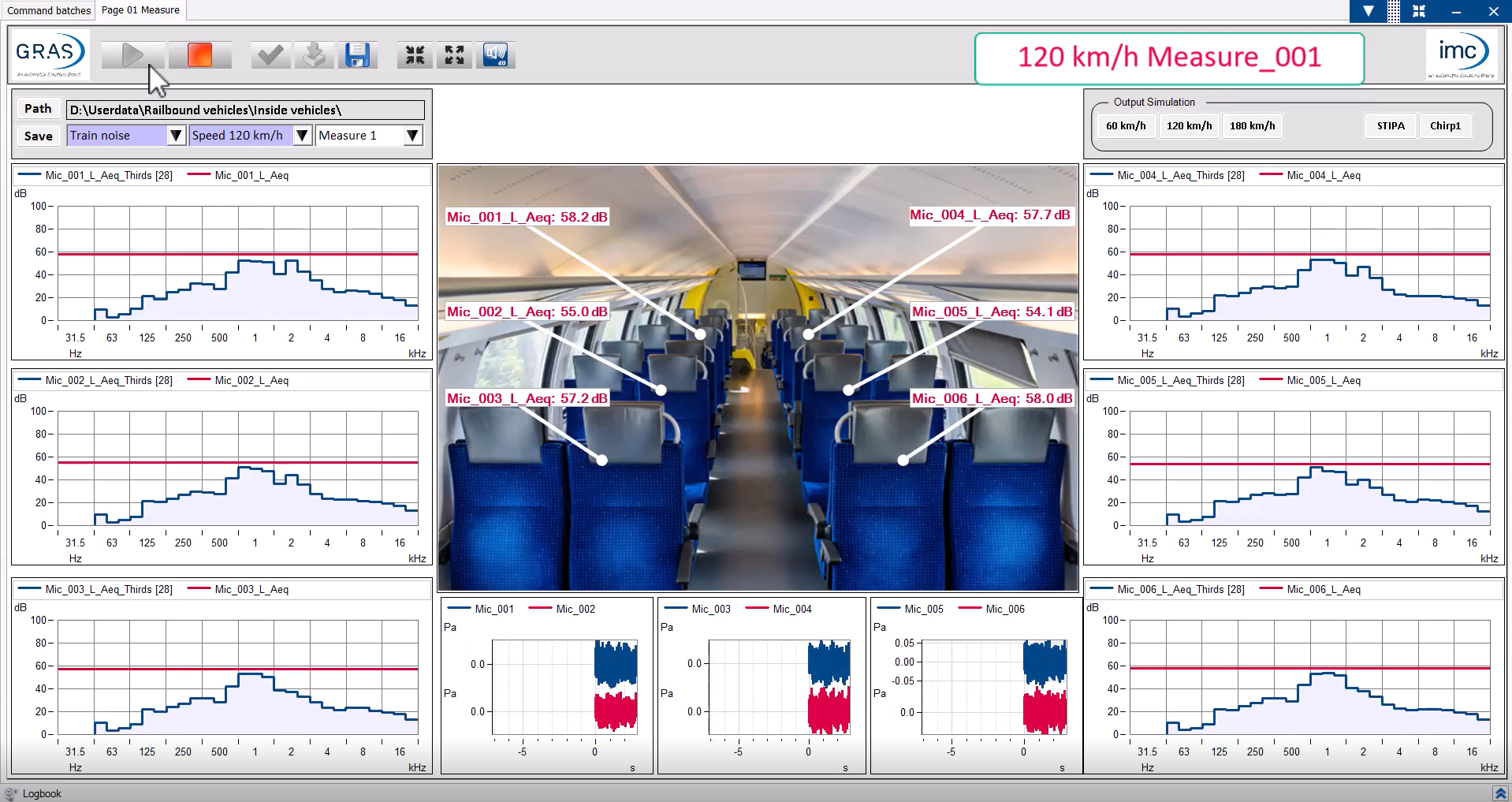
imc DAQ systems integrate easily into existing toolchains:
- Seamless import of sensor lists, thresholds, and metadata into data analysis software FAMOS.
- Export to MATLAB®, Python®, or DIAdem™
- Standard formats (MDF4, CSV, HDF5) for universal data access
- Direct links to databases and network storage
Why use distributed DAQ for rail vehicle testing?
When signal paths are long or space is tight, traditional centralized systems struggle. A distributed setup delivers clear advantages.
What can be measured across a rail vehicle?
Distributed data acquisition on trains are used at various stages of train or component development.
Typical applications are:
- Full-train test runs and validation
- Functional testing of bogies, brakes, or HVAC systems
- Structural and fatigue measurements on car bodies
- Comfort and vibration testing (EN 14363, ISO 3381, ISO 3095)
- Thermal and climate testing
Distributed DAQ systems can simultaneously acquire a wide variety of analog, digital, and vehicle-bus signals. Typical measurement parameters include:
What should engineers look for in a distributed rail DAQ system?

Distributed doesn’t automatically mean synchronized or robust. Engineers that need to apply a distributed DAQ infrastructure should check for four crucial functions of a data acquisition system.
Sample-accurate synchronization
Network timestamps alone aren’t precise enough. Sample-accurate synchronization is essential when analyzing related events such as braking forces, vehicle dynamics, and structural vibrations.
Distributed DAQ systems use synchronization technologies to ensure that measurement data from different modules and railcars shares a common time reference - depending on the system architecture, synchronization methods include GPS, IRIG-B, Precision Time Protocol (PTP), dedicated synchronization cables, or deterministic communication networks such as EtherCAT.
imc CRONOSflex and imc ARGUSfit support synchronized distributed measurements, enabling precise temporal correlation of signals acquired across multiple railcars.
Flexible power concepts
Distributed DAQ setups need to have an efficient power supply. Especially for long-distance measurements, reliable power distribution is an important consideration when designing the DAQ network. Common solutions are DAQ modules powered through local power supplies, dedicated power connections, or compatible power-over-data technologies.
Power-over-Ethernet (PoE) or local feed-in options reduce cabling and are efficient. For example, imc CRONOSflex supports a modular power concept that can simplify cabling by combining power supply and data communication.
The appropriate power architecture depends on the number of measurement modules, their power requirements, installation distances, and available onboard power sources.
EMC-robust data transmission
Rail environments exposes systems to strong electromagnetic fields. Particularly in railway environments traction equipment, high-voltage systems, and powerful electric drives generate strong electromagnetic fields.
Fiber-optic communication enables high-speed digital data transmission over long distances while providing electrical isolation and immunity to electromagnetic interference.
imc ARGUSfit supports fiber-optic connections for distributed measurement applications. It connects distributed measurements modules via fiber-optic links, maintaining signal integrity and reducing the risk of interference-related communication errors.
Centralized control and integrated real-time processing
Users shouldn’t have to manage complexity module by module - real-time calculations within the imc DAQ devices can include signal filtering, statistical evaluations, threshold monitoring, and derived measurement quantities.
With the measurement software imc STUDIO and integrated real-time processing capabilities, engineers can visualize measurement data, monitor limit violations, and perform initial evaluations before transferring data to FAMOS for detailed post-processing.
Distributed data acquisition with imc


imc ARGUSfit
Compact and modular, distributable over long distances, robust and autonomous, sampling rates up to 500 kS/s per channel
Learn More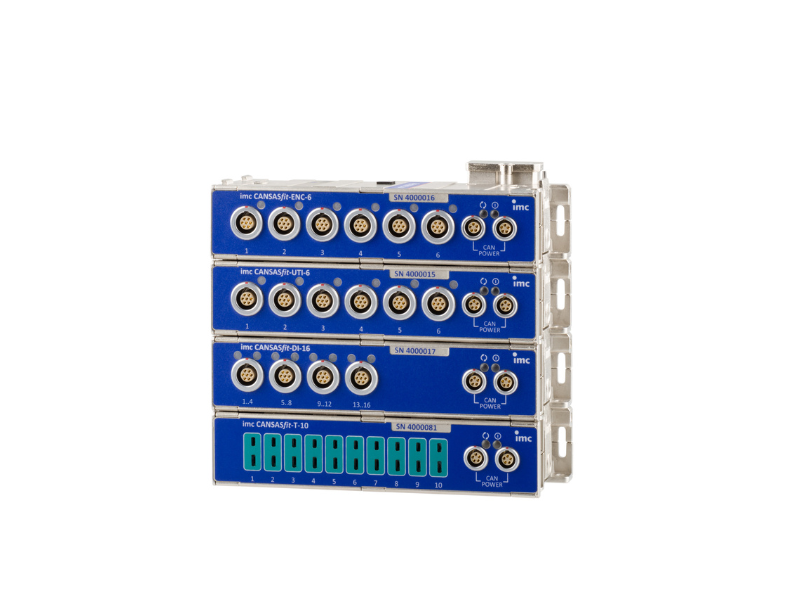
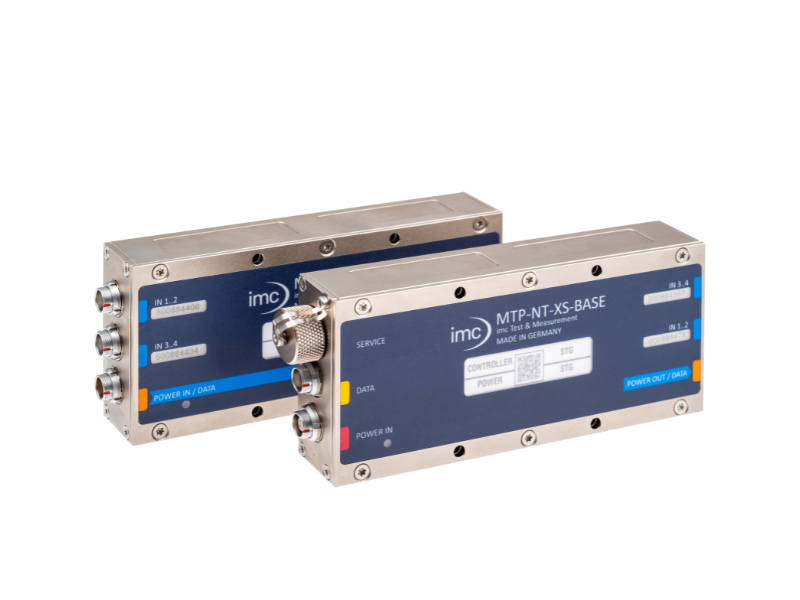
Telemetry DAQ Solutions
Wireless measurement data transmission on rotating components, robust against harsh environments
Learn MoreWhat does distributed data acquisition on rail vehicles involve?
Distributed data acquisition is a measurement approach in which multiple DAQ modules are installed close to sensors at different locations throughout a rail vehicle or train. Instead of routing all sensor signals to one central measurement unit, the modules digitize signals locally and transmit the data through a synchronized communication network. This enables accurate, time-aligned measurements across multiple railcars, making distributed DAQ particularly suitable for structural testing, brake testing, vehicle dynamics, noise and vibration (NVH) analysis, and railway certification.
The main difference lies in where sensor signals are digitized and how measurement data is transmitted. In a centralized DAQ system, sensors throughout the vehicle are connected to one central measurement unit, often requiring long analog cables. In a distributed DAQ system, multiple measurement modules are
positioned close to the sensors. Signals are digitized locally and transmitted through a communication network to a central recording or analysis environment.
Centralized DAQ | Distributed DAQ |
| One central acquisition location | Multiple measurement modules |
| Longer analog sensor cables | Shorter analog sensor cables |
| Greater risk of interference over long distances | Reduced susceptibility to interference |
| More complex wiring for widely separated sensors | Simplified cabling across railcars |
| Expansion may require additional centralized hardware and wiring | Modular expansion near measurement points |
| Suitable for compact measurement setups | Ideal for complete rail vehicles and multi-car testing |
Distributed data acquisition is particularly advantageous for large-scale rail testing applications that require flexible installation, high channel counts, and precise synchronization across widely separated measurement points.
Positioning DAQ modules close to sensors reduces the length of analog signal cables, minimizing electromagnetic interference (EMI), signal degradation, and installation complexity. The main benefits include improved signal quality, fewer cables, lower installation effort, and greater flexibility when configuring measurement setups. Digitized signals can be transmitted over longer distances via Ethernet, EtherCAT, CAN, or fiber-optic connections without the same susceptibility to interference as analog sensor signals. This is particularly important in rail vehicles, where high-voltage equipment, traction systems, and long distances between measurement points create challenging conditions.
Distributed DAQ systems use synchronization technologies to ensure that measurement data from different modules and railcars shares a common time reference. Depending on the system architecture, synchronization methods include GPS, IRIG-B, Precision Time Protocol (PTP), dedicated synchronization cables, or deterministic communication networks such as EtherCAT.
For example, imc CRONOSflex and imc ARGUSfit support synchronized distributed measurements, enabling precise temporal correlation of signals acquired across multiple railcars. Sample-accurate synchronization is essential when analyzing related events such as braking forces, vehicle dynamics, and structural vibrations.
Modern distributed rail DAQ systems can acquire hundreds to several thousand measurement channels simultaneously, depending on the system architecture, sampling rates, and communication bandwidth.
Modular systems such as imc CRONOSflex and imc ARGUSfit allow engineers to expand measurement networks according to their testing requirements.
For example, imc ARGUSfit supports up to 1,000 channels per system, while synchronized networks can combine more than 1,000 measurement channels across multiple railcars. This scalability enables everything from targeted component testing to comprehensive measurements of complete trains.
Distributed DAQ systems can simultaneously acquire a wide variety of analog, digital, and vehicle-bus signals.
Typical measurement parameters include:
- Mechanical signals: Strain, force, torque, pressure, displacement, and wheel-rail contact forces.
- Dynamic signals: Acceleration, vibration, shock, and rotational speed.
- Acoustic signals: Sound pressure, noise, and NVH measurements.
- Electrical signals: Voltage, current, and high-voltage system parameters using suitable isolated measurement modules.
- Thermal signals: Temperature measurements using thermocouples or resistance temperature sensors.
- Vehicle-bus signals: CAN, CAN FD, MVB, and other supported train communication protocols.
- Position and operating data: GPS coordinates, vehicle speed, and digital status signals.
Synchronized acquisition allows engineers to correlate these signals and analyze complex interactions between vehicle components and systems.
Vehicle-bus data can be synchronized with analog measurement signals by acquiring both data types within a common DAQ environment and assigning timestamps based on a shared time reference.
Specialized bus interfaces or data loggers, such as imc BUSDAQ, capture information from vehicle networks including CAN and MVB. The recorded bus data can then be correlated with analog signals such as strain, acceleration, brake pressure, or temperature. This enables engineers to compare vehicle control commands and operating states with the actual physical response of the rail vehicle. For example, brake control data can be analyzed alongside measured braking forces and vehicle deceleration to evaluate braking performance.
Proven in rail vehicle testing
Efficient, Rugged, Connected - imc distributed DAQ systems provide a solid foundation for safe, efficient, and standards-compliant testing of modern rail vehicles. From individual components to entire trainsets, the modular concept offers maximum flexibility with minimal installation effort.
Your benefits:
- Up to 70 % less cabling
- Best-in-class signal quality through at-source digitization
- Microsecond-accurate sync across 1,000 + channels
Field-proven in hundreds of rail projects worldwide.
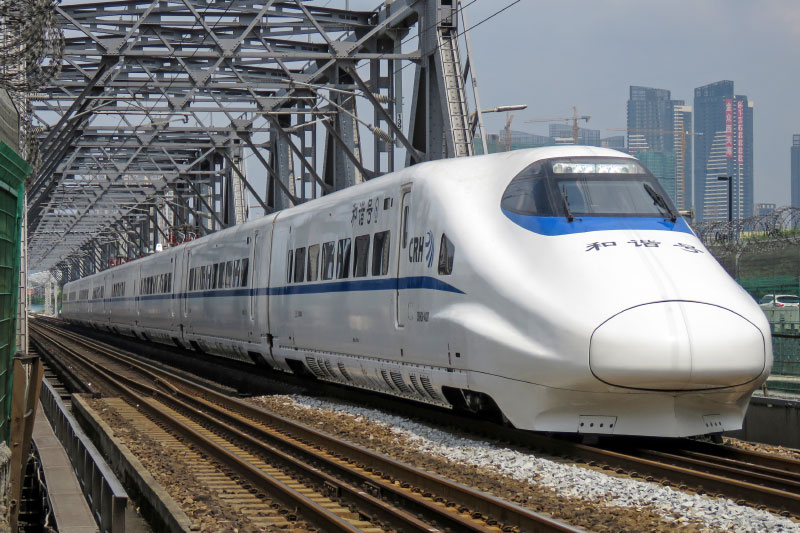
From prototype to series approval
During train development, hundreds of sensors record strain, temperature, and acceleration across the vehicle. Distributed imc CRONOSflex modules digitize these signals at the source and stream them synchronously to the base unit—providing real-time insight into entire subsystems.
Read the application note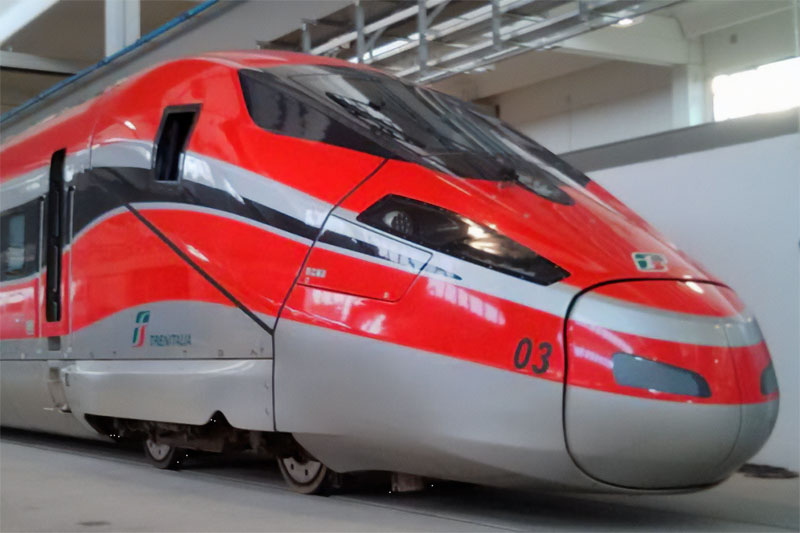
High-speed train certification
For the certification of the Frecciarossa 1000, Italcertifer captured more than 300 channels across several cars using imc CRONOSflex and imc CRONOScompact.
Acceleration, force, temperature, and bus data were logged synchronously at up to 100 kS/s per channel and analyzed in real time.
Planning a distributed measurement setup for a rail vehicle?
Find the right railway measurement solution
Tell us what you’d like to measure.
Talk to a measurement specialist and discuss your measurement setup.
We’ll recommend the right imc measurement system for you—with no obligation and with technical advice from experts who understand web measurement technology.
✓ No obligation—technical advice with no strings attached
✓ Direct communication with an imc measurement technology specialist
Other rail vehicle test solutions by imc

High-voltage pantograph testing
What is measured?
Voltage, current, contact force, acceleration, position, bus data.
Main challenge?
HV isolation, EMC, distributed measurement
Solution?
Isolated synchronized DAQ close to the measurement point
Explore pantograph testing

Railway acoustic & NVH testing
What is measured?
Sound pressure, acceleration, vibration, speed, GPS/position
Main challenge?
Standards compliance and synchronization of acoustic/mechanical data
Solution?
Synchronized multi-channel acoustic & vibration acquisition and analysis
Explore railway NVH testing

Wheelset & compontent on-track testing
What is measured?
Wheel-rail forces, strain, torque, acceleration, temperature
Main challenge?
Rotating parts, vibration, water, debris, limited installation space
Solution?
Rugged telemetry + distributed DAQ
Explore wheelset testing

Back to rail vehicle test overview
Explore the rail vehicle test solutions by imc
Explore rail test solutions overview