


Decentralised Measurement Technology in the Railway Sector
Decentralized Distributed Sensor Networks
Decentralised distributed measurement technology describes systems in which measurement data is not recorded centrally but directly at the point of origin, where it is then processed and evaluated. This is made possible by the use of distributed measurement nodes that are installed in close proximity to the sensors and communicate with each other via networks.
Decentralised Measurement – Effective, Flexible and Safe
Just as numerous individual measuring points are distributed across the wagons in a train, the measuring system should also be decentralised. It consists of local amplifiers, data recording and storage modules that can be placed flexibly and as required directly on the sensors. This eliminates the need for complex installation of long, fault-prone and expensive sensor cables. At the same time, electromagnetic interference is reliably avoided.
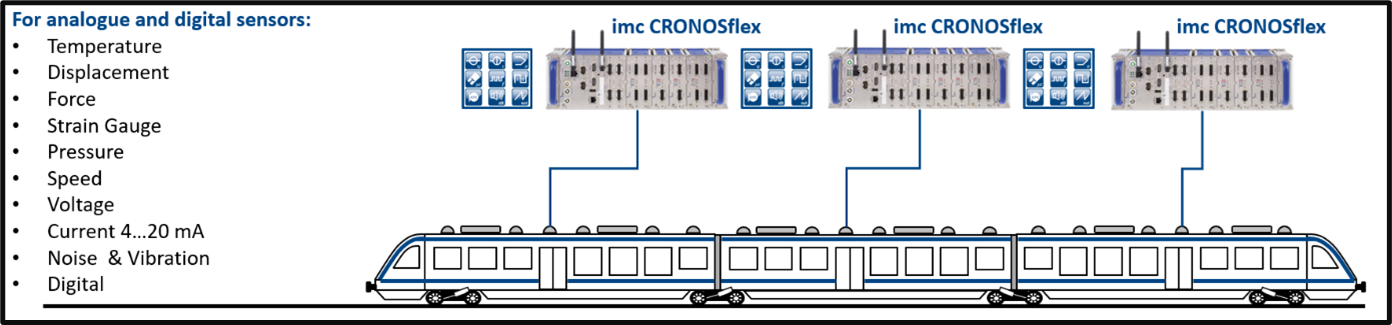
With its network-based, modular system architecture, the imc CRONOSflex or imc ARGUSfit measurement system offers the ideal platform for this. The accompanying imc STUDIO software not only enables the configuration and display of measurement data at the workstation, but also ensures that all data can be monitored and visualised in parallel and supplemented with live text and audio (voice) comments via monitor stations or monitor PCs.
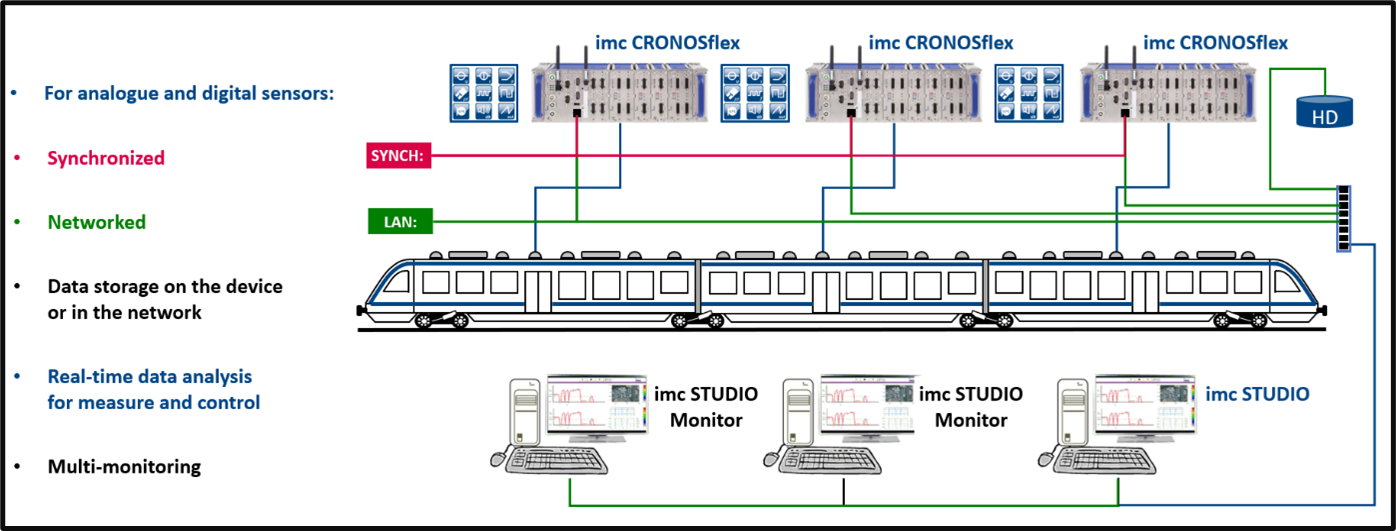
This additional meta information is precisely assigned to the corresponding measurement channels, stored and, together with video channels, forms an integrated overall concept that brings together analogue, digital, virtual (calculated), fieldbus and multimedia data sources.
The complete data pool is then available for intelligent storage management and further analysis with imc FAMOS. This allows well-founded results to be generated, which serve as a valuable basis for decision-making for developers and test engineers – for example, for brakes, chassis or drive systems.
Distributed, Decentralised Measurement Systems
imc Test & Measurement has been developing and supplying distributed, decentralised measurement systems since the 1990s – not only for the railway industry, but across a wide range of sectors. With the advent of Industry 4.0, this approach has become a megatrend that is now in demand in almost all areas of manufacturing, mobility and infrastructure.
Advantages of Decentralised Measurement Technology:
- Lower latency: Data processing takes place close to the sensor, enabling rapid responses to process changes
- Reduced cabling: The proximity of sensors and measuring nodes eliminates the need for long cable runs, reducing costs and minimising interference
- Easy expandability: Components can be flexibly combined and replaced as required, making it easy to adapt to different requirements. Robustness: Distributed systems are often designed for use in harsh environments and deliver reliable data even under difficult conditions.
- Real-time data analysis: imc systems enable immediate processing and analysis of the collected data, which supports fast decision-making
Challenges
Despite its many advantages, decentralised distributed measurement technology also presents a number of challenges:
- Complexity of synchronisation:
Precise timing between multiple measurement nodes requires special procedures, especially over long distances. imc offers various solutions for this. With a specially developed, innovative process, imc guarantees precise, sample-accurate synchronisation across all units.- Synchronisation via a synchronisation cable
- Synchronisation via GPS
- Synchronisation via PTP network (Precision Time Protocol)
- Increased effort for power supply:
Multiple decentralised modules must be reliably supplied with power, which can make planning more complex. Here, imc offers practical solutions, such as power supply directly via the communication cable – e.g. with Ethernet via Power over Ethernet (PoE). - Costs for additional components:
The integration of special interface and distribution modules can increase investment costs. However, the imc standard parts concept optimises system costs, resulting in an attractive price-performance ratio.
Overall, imc's decentralised distributed measurement technology offers a future-proof, flexible and efficient solution for modern measurement tasks – especially in demanding and dynamic fields of application such as the railway industry.
Modular Data Acquisition Systems
- imc CRONOSflex: Flexible, frameless DAQ system with distributed modular architecture. Modules can be connected via Ethernet or EtherCAT over distances of up to 100 m. Multiple units can be operated synchronously – ideal for widely spaced measurement points.
- imc ARGUSfit: Click-modular, highly flexible system with up to 1000 channels and a total sampling rate of 5 MS/s. Real-time processing takes place directly in the device. The system can be expanded as required – for example with fieldbus or UPS modules – and can be seamlessly synchronised with other systems.
- imc CANSAS & BUSDAQ: Intelligent measurement amplifiers and data loggers based on CAN bus or BUSDAQflex. Robust and decentralised, they offer up to 20 kHz sum sampling rate per node – ideal for distributed measurement tasks.
Rugged Field Devices:
Designed for use in harsh environments: The imc PROTECT series is particularly resistant to extreme temperatures (–40°C to +85°C) and electromagnetic influences – ideal for wind turbines, rail vehicles and industrial applications in electromagnetically polluted environments.
Telemetry Integration
imc telemetry solutions enable fully integrated, wireless measurements – specifically designed for use in railway and aircraft technology. Synchronous connection to existing DAQ systems is guaranteed at all times.
