


Optimizing Aircraft Performance:
A deep dive into torsional vibration analysis with FAMOS
Unmanaged mechanical stresses between the engine and propeller of turboprop powertrains can lead to critical safety and efficiency issues for airplanes relying on these designs for propulsion. Torsional vibrations which are not mitigated through the powertrain can build stress in key components, with elevated risk for both performance issues and critical failures. Precise measurement and analysis are essential to avoiding such failure modes.
In this blog post, we demonstrate how you can analyze these vibrations and evaluate the effectiveness of vibration dampers using FAMOS projects.
Written by Daniel Förder, Strategic Product Manager Software and FAMOS expert
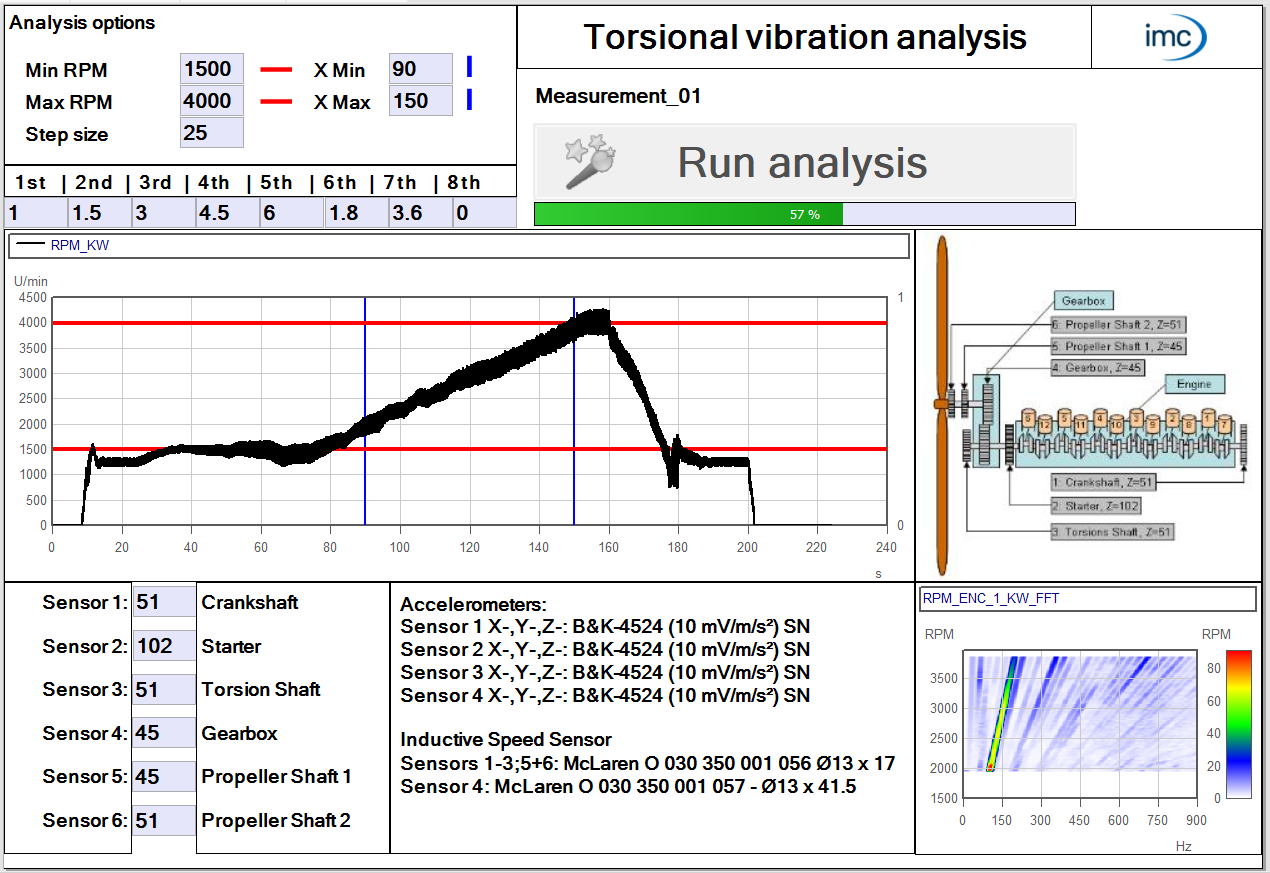
Getting started with the FAMOS demo project:
The analysis begins with a demo project that is designed to handle approximately 200 MB of data per test run. Upon loading, the project presents a clear graphical interface representing a combustion engine and its gearbox system. The setup includes six RPM pickup locations positioned at different points along the crankshaft and gearbox. As these locations use different tooth wheels, the software enables specific inputs to match the correct tooth count for each sensor.
What is it about?
The primary objective of this analysis is to examine the run-up or run-down phases of the engine. By comparing the torsional vibration levels near the combustion engine (the source) with those near the prop shaft, engineers can assess the performance of the vibration dampers. Ensuring that these dampers are functioning correctly prevents excessive vibration from reaching the propeller blades, which could otherwise result in structural fatigue or failure.
Interactive analysis and order tracking
One of the most powerful features of this FAMOS demo project is the ability to select data interactively for analysis:
- Visual Selection: Users can use red and blue markers on the RPM signal plot to “cut out” specific sections of a run-up or run-down for in-depth analysis
- Order Tracking: The interface includes dedicated inputs for selecting orders to analyze, enabling users to focus on particular harmonic components of the vibration
- One-click execution: Once the parameters have been set, clicking “run” will carry out all aspects of the analysis automatically
Visualizing the results
The results are presented across several detailed pages, providing multiple perspectives on the data:
- Frequency Spectrum Color Maps: These maps display deviations of RPM for all frequencies and across the tested RPM range. For that, the RPM signals are high-pass filtered before performing FFT calculations. High-pass filters without phase shift are used for best result quality. At the crankshaft (closest to the engine), deviations of up to 90 RPM may be visible. However, as you move towards the propeller, the amplitude drops significantly—in this case, to less than 7 RPM—demonstrating the dampers' efficiency
- Order spectra: For a 12-cylinder engine, the third order is usually the strongest component. The software allows you to compare these spectra before and behind the vibration damper to see the exact reduction in amplitude
- Linked Cursors: To analyze specific data points in more detail, FAMOS provides linked cursors that allow you to 'cut through' color maps in x and y direction, updating separate slice plots in real time
- Scaling options: The software can scale amplitudes in degrees beyond just RPM variation, offering a different perspective on the rotational displacement caused by vibration. That aspect of the project utilizes the FAMOS functions to convert between units, scaling the RPM signals to angular velocity (in degrees per second), and then integrating that to have the absolute angle signal. Again, to focus on the deviations, a high-pass filter is applied.
Using these advanced analysis tools, engineers can gain a comprehensive understanding of torsional vibration, from overall vibration lines to specific first, third, and sixth orders. This level of insight is vital for ensuring that every component, from the gearbox to the propeller blades, operates within safe limits. With some modifications, this example can as well be used for completely different torsional vibration tasks on drive shafts in shipbuilding, automotive, aerospace and much more.
