• A leader in the test & measurement space
  • Audio Analyzers & Testing by Audio Precision
  • GRAS Sound and Vibration
  • imc Test & Measurement GmbH - productive testing
imc Test & Measurement GmbH
GRAS
  • Products
    Data Acquisition Systems
    • ARGUSfit - miniature
    • CRONOSflex - clickable
    • CRONOScompact - rack-based
    • CRONOS-XT - rugged & modular
    • CRONOS-SL - rugged
    • C-SERIES - small & versatile
    • SPARTAN - low-speed
    • EOS - high-speed
    • BUSDAQflex - vehicle-bus logger
    • CANSAS - CAN-based
    • Legacy Products
    Measurement Software
    • FAMOS - test data analysis
    • imc STUDIO - measurement & control operation
    • imc Online FAMOS - real-time analysis
    • imc WAVE - live NVH analysis
    • imc LINK - remote data transfer
    • imc SENSORS - sensor database
    • Legacy Products
    Sensor Solutions
    • WFT - 6-component Wheel Force Transducer
    • WTT - Wheel Torque Transducer
    • CLSx - Steering Effort Sensor
    Telemetry
    • Dx – modular telemetry system
    • MTP-NT - inductive transmission
    • CTP-NT-Rotate – compact radio telemetry
    • T1 – 16 bit single channel telemetry
    • TEL 1 –12 bit single channel telemetry
    • TEL1-Flex – bendable single channel telemetry
    Test Stands
    • Component Test Stands
    • Endurance Test Stands
    • Retrofit
    • Realized test stands
  • SOFTWARE
    • FAMOS
    • imc STUDIO
    • Online FAMOS
    • imc WAVE
    • imc LINK
  • Solutions
    Industries
    • Automotive
    • Rail
    • Aerospace
    • Energy & Power Grid
    • Mechanical Engineering
    • Civil Engineering
    Applications
    • E-Mobility Applications
    • Test Stands
    • Noise & Vibration Analysis
    • Measurement Data Analysis
    • Durability testing
    • Strain Gauge Measurements
    • imc measurement devices in the "Internet of Things"
    • Condition Monitoring
    • Fieldbus Integration
  • Resources
    imc Academy
    • About imc ACADEMY
    • Training Calendar
    • Training Programs
    • Seminars
    • Workshops
    • Digital Courses
    • Coaching & Consulting
    Tradeshows & Events
    • Automotive Testing Expo Stuttgart 2026
    • Noise-Con 2026
    • AES Automotive Audio 2026
    • Automotive Testing Expo Shanghai 2026
    • Innotrans 2026
    • ATE North America 2026
    Webinars
    • Advancing Rail Safety: TÜV Süd & imc
    Product Downloads
    • Data Acquisition Systems
    • Measurement Software
    • Sensor Solutions
    • Telemetry
    • VIEW THE KNOWLEDGE CENTER
    Whitepapers
    • Mitigating damage from vibrational resonance
    • Spectrum analysis for sound power measurement
    • Mechanical power measurements on drive systems
    • From the sensor to data to added value
    • Integrated Component Test Stands
    • Ground vibration testing
    App Notes
    • Czinger 21C Safety & Durability Testing
    • Prevention of torsional vibration on wheelsets
    • imc Application Note: Liebherr BEV Mining Truck
    • Dynamic load testing of rail wheelsets
    • SBB monitors Swiss railways with imc
    • Testing Safely in High-voltage Environments
    News
    • News: E-motor test stands
    • VIEW THE KNOWLEDGE CENTER
    Press
    • Press Releases
    • VIEW THE KNOWLEDGE CENTER
  • Support
    Customer Service
    • Device Rental/Personnel Contracting
    • CE conformity
    System Service
    • Sending in a device for maintenance
    • Express Service
    About
    • Company Profile
    • CAEMAX
    • KMT
    • Jobs
    • Locations
    • General Terms & Conditions
    • Export declaration
    • Quality Assurance
    • imc Worldwide
    • Becoming a partner
    • Partner Portal
  • Contact Us
    • Contact Sales
    • General Contact
    • Become a Partner
    • Locations
    • +44 7985564945
  • English
  • Deutsch (de)
  • Chinese (Simplified)
  • South Korean
  • French
  • Hungarian
  • Chinese (Traditional)
  • Finnish
  • Spanish

Axiometrix Solutions Family

  • Axiometrix Solutions
  • Audio Precision
  • GRAS Sound & Vibration
  • imc Test & Measurement
  • English
  • Deutsch (de)
  • Chinese (Simplified)
  • South Korean
  • French
  • Hungarian
  • Chinese (Traditional)
  • Finnish
  • Spanish
LOG IN | SIGN UP
Thermal Management of EV-Batteries

Thermal Management of EV-Batteries

  1. Home
  2. Solutions
  3. Industries
  4. Thermal Management of EV-Batteries

Understanding the thermal behavior of EV batteries

Electric Vehicles (EVs) represent the future of environmentally friendly transportation. The global market for electric cars has experienced a consistent increase in sales over the last decade. The safety concerns surrounding the use of lithium-ion batteries in electric vehicles are becoming more prominent as these batteries become more powerful, charging times become faster, and the size of battery packs increase to extend the driving range.

Materials with higher energy density may possess lower thermal stability, which can pose safety issues like battery thermal runaway. Battery thermal management has become crucial in managing the greater energy densities and specific powers of batteries while also predicting, preventing, and containing any hazards or fires that may arise. It is an essential aspect of individual cell and module, battery pack, and overall vehicle design. The investigation into battery failures, fires, and recalls has revealed that they are often caused by mechanical, electrical, and thermal abuses.
Thermal management of lithium-ion batteries in EVs presents several challenges when it comes to temperature measurement systems.

Some of the Key Challenges Include:

  • Sensor placement
  • Sensor accuracy and reliability
  • Calibration and calibration drift
  • Data synchronization and integration
  • Data transmission and communication
  • Data processing and analysis

Safety Considerations:

With high energy lithium-ion batteries, safety is paramount. It is a major challenge to ensure that temperature measurement does not jeopardize user safety or pose additional risks.

Many different temperature measurements across the full architecture are necessary ranging from the battery itself to the connectors to the power electronics all the way to the electric motor. Placement and installation of the sensors and DAQ systems can be particularly difficult during prototype testing.

Contact us regarding your project

Data Acquisition Strategies for Effective Thermal Management

Effective thermal management in EVs is essential for maintaining optimal performance, ensuring safety, and prolonging the lifespan of critical components. Temperature data acquisition is a fundamental aspect of this management.


Placing Temperature Sensors

Strategically Placing Temperature Sensors throughout the EV is Crucial for Gathering Accurate and Comprehensive Temperature Data:


Battery Pack

Sensors should be evenly distributed within the battery pack to detect temperature variations. These sensors help identify hotspots and enable the BMS to take appropriate measures to ensure battery safety and longevity.


Power Electronics:

Fiber-optical temperature sensors can be positioned within power electronics components, complementing traditional sensors, to monitor temperature accurately and reliably. These sensors trigger cooling systems when needed, preventing overheating and optimizing performance.


Electric Motor:

Sensors, both traditional and fibre-optic, can be placed around the electric motor to monitor its temperature in real time. This is essential for maintaining efficiency and preventing motor damage.


Cabin Comfort:

Interior temperature sensors enable precise monitoring and control of passenger comfort while minimizing energy consumption.


Types of Sensors

Each type of sensor has its unique advantages and applications:

Thermocouples:

Renowned for their ruggedness and wide temperature range, thermocouples are suitable for measuring the temperature of critical components like the electric motor and power electronics.


RTDs:

Offering higher accuracy and stability, RTDs excel in battery pack temperature monitoring. Their precision is essential for the Battery Management System (BMS) to optimize charging and discharging.


Infrared Sensors:

These non-contact sensors provide surface temperature measurements, making them valuable for assessing various components within the EV.


Fiber-Optic Temperature Sensors:

Fiber-optic sensors are increasingly used in EVs due to their unique benefits. They offer accurate temperature monitoring and can be more easily and safely placed in areas with electromagnetic interference, high voltage, or in hard-to-reach locations.


Data Processing and Analysis

Temperature data collected from these sensors, including fibre-optic ones, must be processed and analysed to make informed decisions about thermal management. Advanced algorithms and control systems interpret this data and take necessary actions, such as activating cooling measures, optimizing insulation, or adjusting HVAC settings.
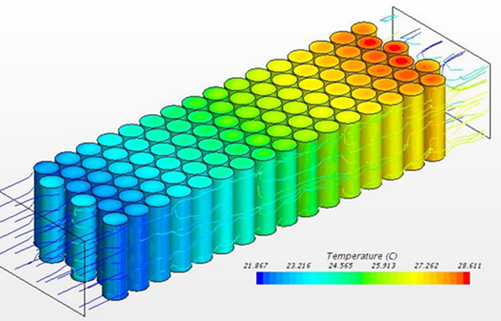

 

Battery Cooling Options for Traction Batteries

The choice of cooling system depends on factors such as the battery chemistry, power density, size, weight, cost constraints, and the specific thermal management requirements of the vehicle. Advanced battery management systems (BMS) often integrate temperature sensors and control algorithms to regulate the cooling system based on real-time conditions, ensuring optimal performance and safety.


Basics:

  • Optimum storage temperature for batteries is around 10°C.
  • The higher storage temperatures lead to faster self-discharge.
  • It is necessary to maintain a 2 – 3 °C temperature gradient from the coolest cell to the warmest cell.
  • Larger packs allow for a wider worst-case gradient of 6 – 8 °C between the battery cells.
  • Large temperature differences lead to different aging of the individual cells.
  • Thermal management ensures the best performance can be maintained even in changing weather conditions or for more aggressive sporty driving styles.

Heat Dissipation

Cooling Systems: Proper heat dissipation is essential to maintain the temperature within safe limits. Cooling systems, such as air or liquid cooling, are often employed in electric vehicles and other applications with high-power batteries.

Battery Management Systems (BMS) incorporate thermal management algorithms to regulate temperature, ensuring that the battery operates within a safe temperature range.

Here are some common battery cooling options:

Passive Cooling

Passive Cooling

The cells are held in an enclosure. Heat generated by the cell is dissipated via conduction, convection or radiated to the enclosure. Used for low power applications.

Example: Nissan Leaf

Passive Cooling + Fan

Passive Cooling + Fan

The cells are held in an enclosure, a fan is used to move air around to create a more even temperature profile across all cells. Typically used for low power applications and where the ambient conditions are below 35°C.


Example: Renault Zoe

Forced Air Cooling

Forced Air Cooling

The cells are in a housing, air is forced through the battery pack to cool the cells. The filtered and cooled air from the cabin can be used.

Example: Toyota Prius

Cooling Plates

Cooling Plates

A cooling fluid that circulates to the battery where heat is transferred to and from the fluid. Most common battery cooling systems in electric vehicles use water-glycol as the cooling fluid.     

Example: Porsche Taycan

Dielectric Immersion Cooling

Dielectric Immersion Cooling

The cells are immersed in a dielectric that flows through a heat exchanger. The dielectric is in direct contact with the cells and busbars, minimizing thermal barriers.            

Example: Koenigsegg Regera, Mercedes C63 AMG

Refrigerant Cooling Plates

Refrigerant Cooling Plates

The cells are thermally connected to a refrigerant cold plate. This is considered less complex because it eliminates the intermediate water-glycol system and applies the refrigerant system directly to the cells. This eliminates a number of parts, potentially making the system cheaper and lighter.


Understanding and controlling the thermal behavior of Li-ion battery cells is critical to maximizing performance, ensuring safety and extending battery life. Manufacturers and researchers are continuously working to develop advanced thermal management systems to meet the ever-evolving needs of electric vehicles and portable electronic devices.


Data Acquisition Systems Measurement Software Sensor Solutions Telemetry Test Stands
FAMOS imc STUDIO imc WAVE imc LINK
FAMOS FAMOS 2026 + AI FAMOS Resources Prices & Editions Try FAMOS
Industries General Applications Automotive Applications
Knowledge Center imc Academy App Notes Whitepapers Tradeshows & Events Webinars Measurement Software News Press Export Declaration
Customer Service System Service Contact Sales General Contact Become a Partner Locations
About imc About Axiometrix Solutions Company Profile CAEMAX KMT Careers Quality Assurance Terms & Conditions Facts
Axiometrix Solutions Logo negativ
imc Test & Measurement is part of Axiometrix Solutions, a leading test solutions provider comprised of globally recognized measurement brands. Productive testing is essential for the success of our customers—hence, our driving force. Since 1988 we have been committed to support industrial innovations with optimal measurement solutions. We are manufacturing our productive test and measurement systems at our headquarters in Berlin, Germany, operating worldwide in Europe, the US and Asia.

© imc Test & Measurement GmbH. All rights reserved.

Legal Notice Privacy Policy REPORT AN INCIDENT
Follow Us:
↑
Loading