• A leader in the test & measurement space
  • Audio Analyzers & Testing by Audio Precision
  • GRAS Sound and Vibration
  • imc Test & Measurement GmbH - productive testing
imc Test & Measurement GmbH
GRAS
  • Products
    Data Acquisition Systems
    • ARGUSfit - miniature
    • CRONOSflex - clickable
    • CRONOScompact - rack-based
    • CRONOS-XT - rugged & modular
    • CRONOS-SL - rugged
    • C-SERIES - small & versatile
    • SPARTAN - low-speed
    • EOS - high-speed
    • BUSDAQflex - vehicle-bus logger
    • CANSAS - CAN-based
    • Legacy Products
    Measurement Software
    • FAMOS - test data analysis
    • imc STUDIO - measurement & control operation
    • imc Online FAMOS - real-time analysis
    • imc WAVE - live NVH analysis
    • imc LINK - remote data transfer
    • imc SENSORS - sensor database
    • Legacy Products
    Sensor Solutions
    • WFT - 6-component Wheel Force Transducer
    • WTT - Wheel Torque Transducer
    • CLSx - Steering Effort Sensor
    Telemetry
    • Dx – modular telemetry system
    • MTP-NT - inductive transmission
    • CTP-NT-Rotate – compact radio telemetry
    • T1 – 16 bit single channel telemetry
    • TEL 1 –12 bit single channel telemetry
    • TEL1-Flex – bendable single channel telemetry
    Test Stands
    • Component Test Stands
    • Endurance Test Stands
    • Retrofit
    • Realized test stands
  • SOFTWARE
    • FAMOS
    • imc STUDIO
    • Online FAMOS
    • imc WAVE
    • imc LINK
  • Solutions
    Industries
    • Automotive
    • Rail
    • Aerospace
    • Energy & Power Grid
    • Mechanical Engineering
    • Civil Engineering
    E-Mobility
    • Temperature measurement in HV environments
    • Current measurement in HV environments
    • Voltage measurement in HV environments
    • Determine efficiency / power analysis
    • Testing electric motors
    • Testing driving dynamics
    • Practical examples
    • Battery test stand
    • Wireless Measurements of Rotor Temperature in E-drives
    • Back-to-Back Test Stand for Data Acquisition on Electric Motors
    Test Stands
    Noise & Vibration Analysis
    General Solutions
    • E-Mobility Applications
    • Measurement Data Analysis
    • Durability testing
    • Strain Gauge Measurements
    • imc measurement devices in the "Internet of Things"
    • Condition Monitoring
    • Fieldbus Integration
  • Resources
    imc Academy
    • About imc ACADEMY
    • Training Calendar
    • Training Programs
    • Seminars
    • Workshops
    • Digital Courses
    • Coaching & Consulting
    Tradeshows & Events
    • AeroTech 2026
    • Sensor+Test 2026
    • Automotive Testing Expo Stuttgart 2026
    • Noise-Con 2026
    • AES Automotive Audio 2026
    • Automotive Testing Expo Shanghai 2026
    • Innotrans 2026
    • ATE North America 2026
    Webinars
    • Advancing Rail Safety: TÜV Süd & imc on Reliable M
    Whitepapers
    • Mitigating damage from vibrational resonance
    • Spectrum analysis for sound power measurement
    • Mechanical power measurements on drive systems
    • From the sensor to data to added value
    • Integrated Component Test Stands
    • Ground vibration testing
    App Notes
    • Czinger 21C Safety & Durability Testing
    • Prevention of torsional vibration on wheelsets
    • imc Application Note: Liebherr BEV Mining Truck
    • Dynamic load testing of rail wheelsets
    • SBB monitors Swiss railways with imc
    • Testing Safely in High-voltage Environments
    Product Downloads
    • Data Acquisition Systems
    • Measurement Software
    • Sensor Solutions
    • Telemetry
    • VIEW THE KNOWLEDGE CENTER
    News
    • News: E-motor test stands
    • VIEW THE KNOWLEDGE CENTER
    Press
    • Press Releases
    • VIEW THE KNOWLEDGE CENTER
  • Support
    Customer Service
    • Device Rental/Personnel Contracting
    • CE conformity
    System Service
    • Sending in a device for maintenance
    • Express Service
    About
    • Company Profile
    • CAEMAX
    • KMT
    • Jobs
    • Locations
    • General Terms & Conditions
    • Export declaration
    • Quality Assurance
    • imc Worldwide
    • Becoming a partner
    • Partner Portal
  • Contact Us
    • Contact Sales
    • General Contact
    • Become a Partner
    • Locations
    • +44 7985564945
  • English
  • Deutsch (de)
  • Chinese (Simplified)
  • South Korean
  • French
  • Hungarian
  • Chinese (Traditional) - Taiwan
  • Finnish
  • Spanish

Axiometrix Solutions Family

  • Axiometrix Solutions
  • Audio Precision
  • GRAS Sound & Vibration
  • imc Test & Measurement
  • English
  • Deutsch (de)
  • Chinese (Simplified)
  • South Korean
  • French
  • Hungarian
  • Chinese (Traditional) - Taiwan
  • Finnish
  • Spanish
LOG IN | SIGN UP

Step-by-step instructions for assembling the ring stator.

Note: for instructions and further details see the manual

  1. Home
  2. Resources
  3. Product Downloads
  4. Telemetry
  5. Dx Telemetry
  6. Ringstator Setup

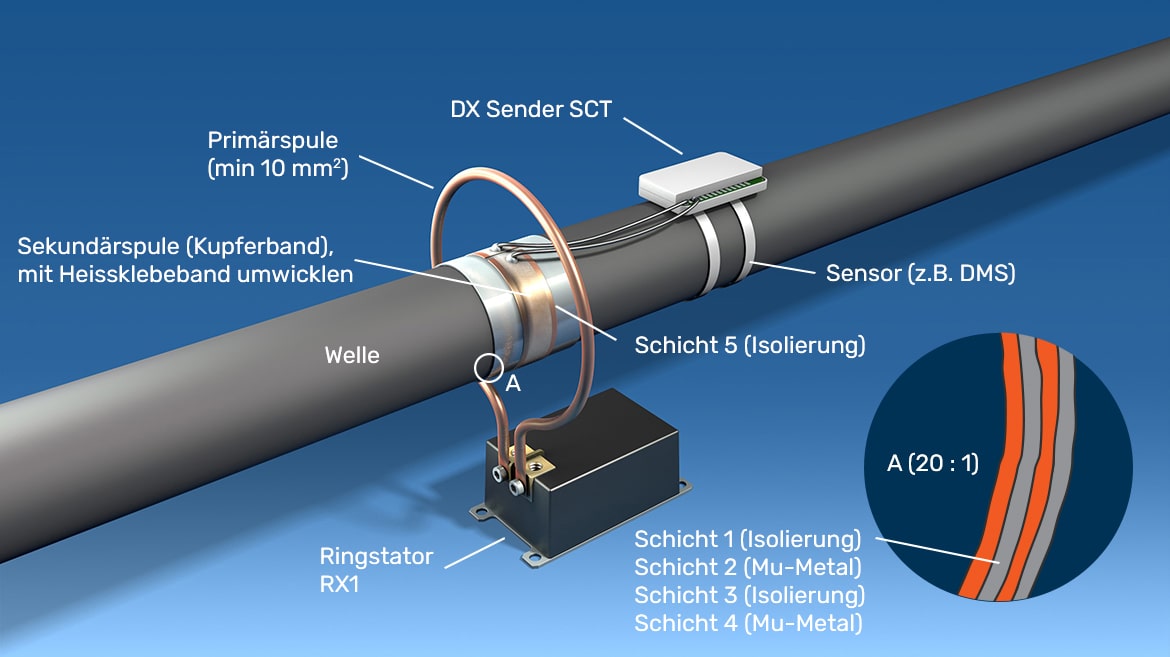
Basic overall structure of the telemetry system with ring stator

The picture shows the basic overall structure of the telemetry system with ring stator and the individual layers of the secondary winding.
Step 1

Wrap the shaft with fabric tape. The insulated surface must be wider on both sides than the Mu metal to be subsequently applied to prevent short-circuiting of the Mu metal with the shaft.

Step 2

The individual components of the mounting set.

Step 3

Calculate the length of the mu-metal with the formula π * diameter + 10 mm. For the diameter, include the previously applied insulating layer.

Step 4

Cut the first layer of mu-metal with protective film to the required length.

Step 5

Apply an overlapping black insulating tape to one end of the Mu metal.

Pull off the protective foil and stick the mu metal onto the shaft. The ends must not touch, there must be no short-circuit winding with the mu metal.

Step 6

Now insulate the Mu metal as described under 1.

Step 7

Now calculate the length of the second mu-metal layer using the formula π * diameter + 10 mm.

Step 8

Cut the second Mu metal layer to this length.

Step 9

Attach an overlapping black insulating tape to one end of the mu-metal. Pull off the protective foil.

Now apply the second mu-metal layer. The overlap of this mu-metal layer must be offset by at least 90 ° to the overlap of the first mu-metal layer. So, for example, rotate the shaft by at least 90 ° before applying the second mu-metal layer.

Step 10

Apply the first layer of heat-resistant Kapton tape (polyimide tape) in the center.

Step 11

Calculate the length of the copper tape for the secondary winding using the formula π * diameter - 5 mm.

Step 12

Cut the copper tape to size.

Step 13

Tin both ends of the copper strip.

Step 14

Now attach the Dx-SCT transmitter unit in a suitable manner.

Step 15

Measure and cut the stranded wire (at least AWG 20 or 0.62 mm2) for the inductive power supply, strip the ends and tin them. Solder one stranded wire each with a maximum length of 100 mm onto the copper strip ends. The connecting leads should be soldered as flat as possible to the copper strip. As drawn in Figure 36, the leads must be aligned at right angles to the copper strip.

Step 16

Now place the copper strip as secondary winding centrally on the polyimide layer. The distance between the copper ends must be approx. 5 mm.

The soldering points with the stranded wire must not touch each other. The strands must be flat and close together. They must not touch the stator when the shaft is rotated.

The sensor leads should not cross with the connecting leads.

For measurements on shafts with high speed or high temperature, imc offers special solutions (half shells, special housings, etc.)

Step 17

Solder the wire ends to the IP1 and IP2 terminals of the Dx-SCT transmitter unit.

Step 18

To secure against centrifugal forces and for protection, the transformer winding must be wrapped with the supplied fabric tape.

Step 19

Calculate the length of the copper ring: (40 mm + diameter) * π + 2 * L

Step 20

Shape the copper wire: Bend the ends and form a bow.

Step 21

Press the copper tube together at both ends.

Step 22

Drill a 5 mm diameter hole in each end of the copper tube.

Step 24

Important: Sand the contact surfaces of the copper tube to reduce resistance.

Step 25

Screw the primary winding to the ring stator.

Step 26

Important: Set the output power regulator to the minimum position by turning it counterclockwise to avoid overvoltage.  

Step 27

Connect the supply cable to the ring stator.

Step 28

Connect the supply cable to the ring stator.

Data Acquisition Systems Measurement Software Sensor Solutions Telemetry Test Stands
FAMOS imc STUDIO imc WAVE imc LINK
Industries General Applications Automotive Applications
Knowledge Center imc Academy App Notes Whitepapers Tradeshows & Events Webinars Measurement Software News Press Export Declaration
Customer Service System Service Contact Sales General Contact Become a Partner Locations
About imc About Axiometrix Solutions Company Profile CAEMAX KMT Careers Quality Assurance Terms & Conditions Grounding Page
Axiometrix Solutions Logo negativ
imc Test & Measurement is part of Axiometrix Solutions, a leading test solutions provider comprised of globally recognized measurement brands. Productive testing is essential for the success of our customers—hence, our driving force. Since 1988 we have been committed to support industrial innovations with optimal measurement solutions. We are manufacturing our productive test and measurement systems at our headquarters in Berlin, Germany, operating worldwide in Europe, the US and Asia.

© imc Test & Measurement GmbH. All rights reserved.

Privacy Policy REPORT AN INCIDENT
Follow Us:
↑
Loading